 Go up
Go up


Using Multiple Filter Conditions
Posted on Apr 14, 2016 by Admin
This week’s SimplyMap report will provide an overview of one of the more advanced functionalities in SimplyMap - applying multiple filter conditions. Filters can be applied to any map or report tabs. For example, a map showing Household income levels by ZIP Code could be filtered to only show ZIP Codes with income over a specific threshold. Another example would be to filter the same income map to only show ZIP Codes with a population over 8,000. Using multiple filter conditions is a great way to hone your focus on a narrower set of geographic locations that meet your multiple criteria. Let’s get started with an example.
Scenario: You are looking for the best location to open up a high end salon in California and want to develop an initial list to further analyze. Let’s assume there are three criteria that must be met before considering a location.
1. The location has to have more than 500,000 residents.
2. The location must have a median household income of at least 75,000.
3. At least 30% of households must report spending money at a salon.
The Setup: First, create a new Location Analysis Report and set your location to California. Next, navigate through some pertinent variables and add the following variables that will serve as our criteria.
# Population, Total (Census Data » People and Households » Age » Total)
Household Inc., Median (Census Data » People and Households » Income » HH Income)
% Households Buying - Expenditures: Amount Spent In Total: Beauty Parlor (MRI Consumer Survey » Purchasing » Average HH Spending)
After you have added all variables you are interested in, close out the Variables panel to generate your report. Results below:
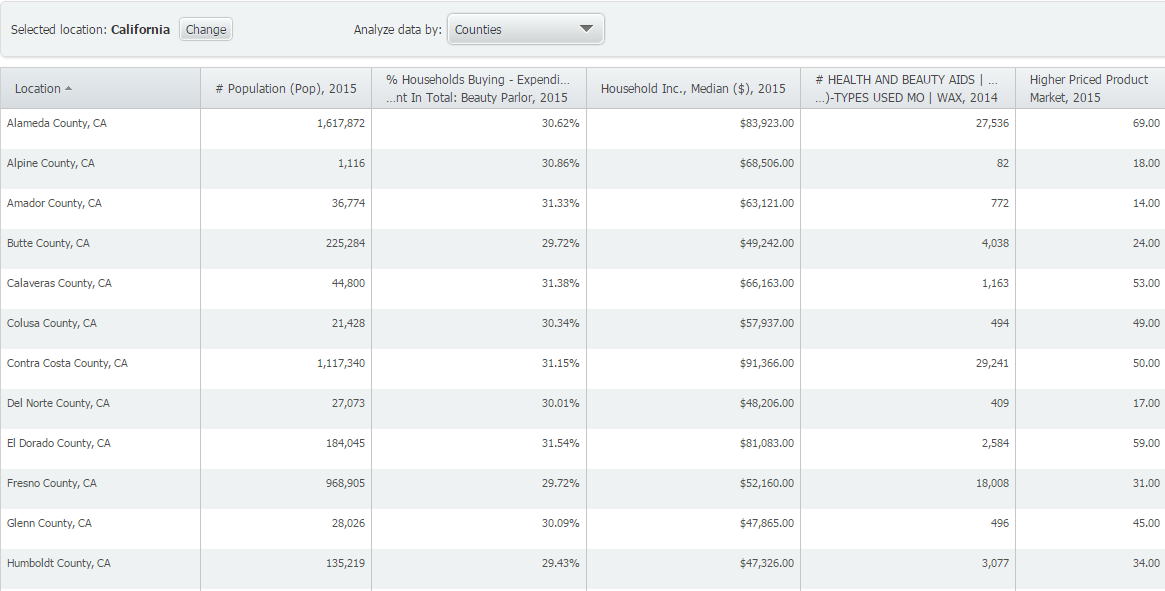
Your initial results will display all counties in California. To create a filter, click on Data Filters > Create New Filter from the top right of SimplyMap. The filter creation dialog will open up.
NOTE: The only variables that will show up as possible filter criteria in the variable dropdown will be either recently used variables, or favorite variables. In this case, we have the variables already in the report, so by default they will show under recently used variables.
1. Select the first dropdown and click on the beauty parlor variable. Leave the second dropdown to “is greater than” and enter a value of 30 in the last box.
2. Click on Add Another Condition to bring up a second variable selection box - choose the population variable and set that to “is greater than” 500,000.
3. Lastly, click on Add Another Condition once more, and find the Median Household Income variable - set this value to “is greater than” 75,000.
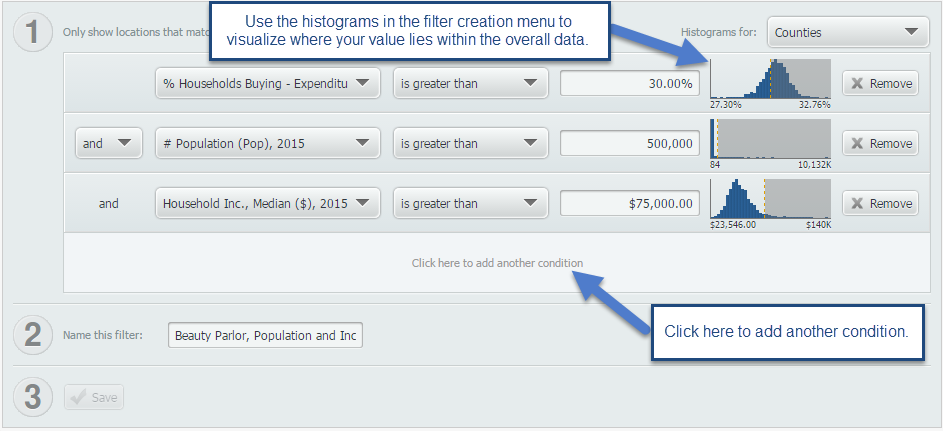
Give your filter a name, and click on SAVE to apply it onto your report. New results below!
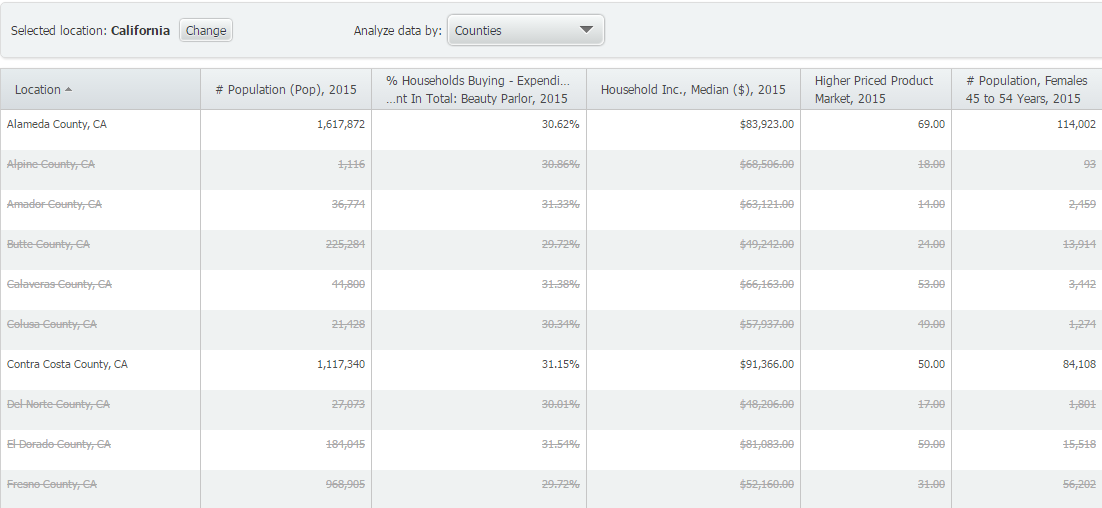
Locations that do not meet your three conditions are then struck out with a line and seen in light gray. If you’d like to hide these locations, click on Display Options > Filtered Locations > Hide. Your final report is shown below:
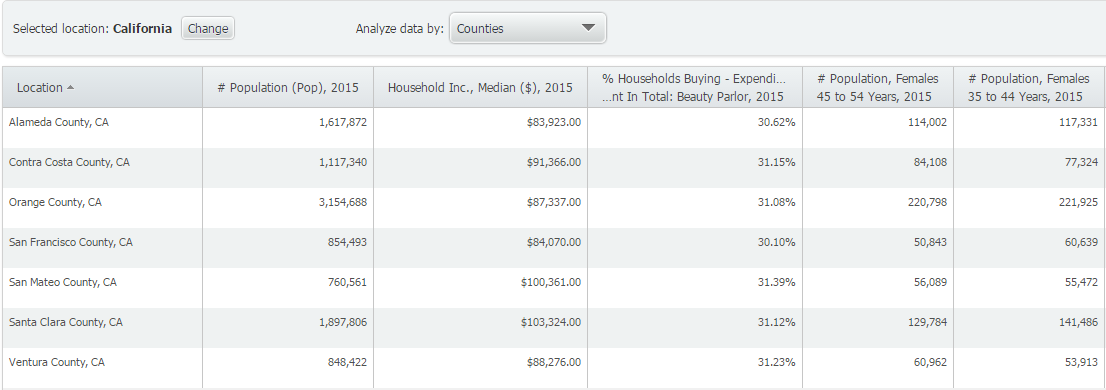
Only 7 of California’s 58 counties meet our specific criteria.
A logical next step for someone doing market research would be to analyze specific ZIP Codes or census tracts within these counties more in depth, and run business reports to see what the competition is like in the target areas.
Do you have any questions on creating and applying filters? Feel free to leave a comment below or send as an email at: support@geographicresearch.com
More from SimplyAnalytics


Posted on Sep 01, 2008 by Admin
The King County Library System in Washington State now subscribes to SimplyMap, and has published a brief review on their blog, Library Talk.
Posted on May 03, 2011 by Admin
The GRI team is very excited to announce the launch of SimplyMap 2.0! Completely redesigned, it is now easier than ever to access data and create professional quality thematic maps and re...
Posted on Apr 21, 2015 by Admin
In this week’s edition of exploring SimplyMap data, we spotlight the Consumer Buying Power® data package in SimplyMap. What is it? The Nielsen Consumer Buying Power® database incorporates...
Posted on Nov 03, 2017 by Admin
This week we’ll talk about one of our favorite features in SimplyAnalytics - the custom combination location. This feature is a simple and effective means to create custom geographies whe...
Posted on Dec 07, 2011 by Admin
We will be exhibiting at the American Library Association Midwinter Meeting & Exhibition in Dallas this January. Visit us at booth 2513 for a demonstration and to have all your Simply...
Posted on Dec 08, 2017 by Admin
Good afternoon, readers! This week we’re going to talk about project management in SimplyAnalytics and how to best take advantage of it. Why are projects needed? Many users have multiple...
Posted on Aug 02, 2016 by Admin
Did you know that you can use SimplyMap to identify which make and model of vehicle is most prevalent within any location in the United States? In this week’s SimplyMap report, we’ll take...
Posted on Dec 16, 2015 by Admin
Visit the SimplyMap team at the ALA Midwinter Meeting 2016 in Boston. We will be at booth #1913 offering product demonstrations, tips & tricks, and of course Ghirardelli Chocolate! Ex...
Posted on Jun 02, 2017 by Admin
We can't wait for ALA Annual this Summer, and the opportunity to share SimplyAnalytics with the ALA community. Stop by the SimplyAnalytics booth (1339) and take a peak at what we've been ...
Posted on Oct 26, 2018 by Admin
Welcome readers! This week we’ll take a look at how to browse for data by category in SimplyAnalytics. Browsing by Category is the default way of browsing for data in SimplyAnalytics. It ...