 Go up
Go up


Exploring SimplyMap Data: Walking to Work in the US
Posted on Aug 13, 2015 by Admin
In this quick SimplyMap report, we use Census data to help us identify which city in the United States has the highest percentage of residents who reported walking to work as their mode of transportation. Have any cities in mind? Let’s find out!
First, click New Ranking from the top of your SimplyMap screen.

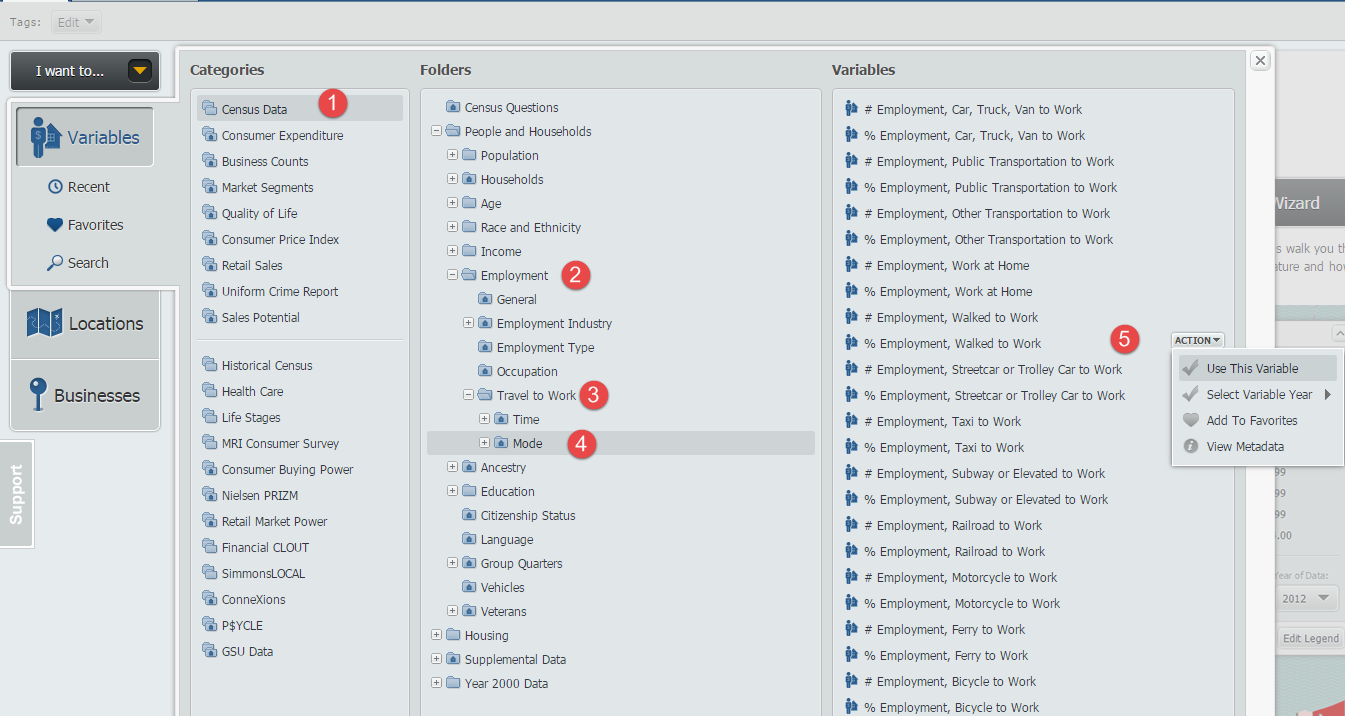
For the variable, follow this path: Census Data » People and Households » Employment » Travel to Work » Mode.
The variable we are looking for is, “% Employment, Walked to Work, 2014”. Picture below for reference.
Click on the Locations panel and select USA as your geography. By default, your report will generate with the Analyze Data By dropdown set to USA. As a good reference point, the USA shows a total of 2.78% of residents who walk to work. Before we analyze the US by city, let’s take a quick look at the US analyzed by top 10 states:

DC coming in with the highest percentage of residents who walk to work, at 12.27%, does not seem too surprising given the relative small land area and highly dense population (over 10,000 people per square mile!). Ranked second, Alaska was surprising to us, and we would be interested in researching more about that - if you know why, feel free to leave a comment below.
Now let’s look at large cities. Switch the Analyze Data By dropdown to Cities and apply a filter to only show cities with a population greater than 100,000. Results are shown below:
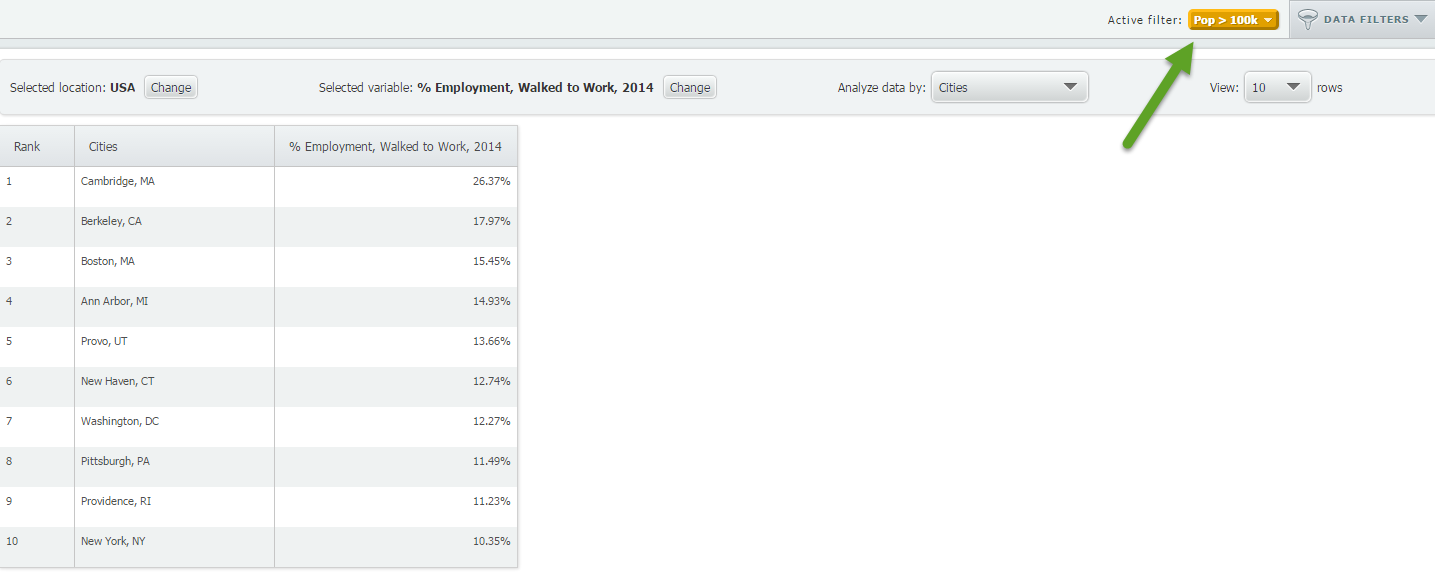
At 26.37%, more than a quarter of Cambridge, MA residents walk to work! We think this might be due to Harvard and MIT being the top employers in the city and within such close proximity to each other.
Honorable mention, and rounding out the top 5:
Berkeley - 17.97%
Boston - 15.45%
Ann Arbor - 14.93%
Provo - 13.66%
That’s it for this week’s SimplyMap report. If there is a particular variable or data package you want to see more of, let us know in the comments below or send us an email or tweet.
More from SimplyAnalytics


Posted on Sep 15, 2025 by Admin
SimplyAnalytics will be attending the upcoming NCLA Conference in Winston-Salem October 14-17!
Posted on Dec 02, 2014 by Admin
Today we take a look at one of the more advanced features in SimplyMap - editing the map legend. Editing the map legend is a great way to not only customize how the data is distributed on...
Posted on Nov 03, 2017 by Admin
This week we’ll talk about one of our favorite features in SimplyAnalytics - the custom combination location. This feature is a simple and effective means to create custom geographies whe...
Posted on Jun 25, 2015 by Admin
In this week’s SimplyMap report, we review the different options available when searching for a business. The easiest and fastest method of mapping businesses or creating a business repor...
Posted on Dec 08, 2017 by Admin
Good afternoon, readers! This week we’re going to talk about project management in SimplyAnalytics and how to best take advantage of it. Why are projects needed? Many users have multiple...
Posted on Apr 30, 2020 by Admin
We find ourselves in the middle of an unprecedented crisis the likes of which most of us have never experienced before, and hopefully won’t have to experience again. There is the occasion...
Posted on Aug 27, 2018 by Admin
Welcome readers! This week we are excited to feature our newest view in SimplyAnalytics, the Time Series Table.What is it?The Time Series Table allows you to quickly pull all years availa...
Posted on Dec 19, 2016 by Admin
Stop by the Geographic Research booth [#T8] at the Ontario Library Association Super Conference to get a hands-on look at our latest and greatest SimplyMap offering. The conference will t...
Posted on Nov 22, 2016 by Admin
We will be exhibiting at ALA Midwinter in Atlanta, Georgia in January. You can find the GRI team at Booth 1155, where we will be catching up with customers old and new, and sharing some e...
Posted on May 08, 2018 by Admin
This summer's ALA conference is in New Orleans and the SimplyAnalytics team will be exhibiting at booth #837. We hope you stop by to learn about new features, check out our new data offer...