 Go up
Go up


Ranking the Highest Population Densities in the US
Posted on Mar 18, 2015 by Admin
Can you guess which US city has the most residents per square mile? Today we’re going to use SimplyMap to answer this question for all cities, as well as cities with a population greater than 100,000. The variable we will be using is a Census Variable, Population Density (per sq. mile), 2014.
First, create a new Ranking Report, and set the geography to USA. Next, navigate through this path to select the variable mentioned above: Census Data » In 2010 Geographies » People and Households » Population » Total.
As a benchmark, the USA comes in with a density of 89 people per square mile.
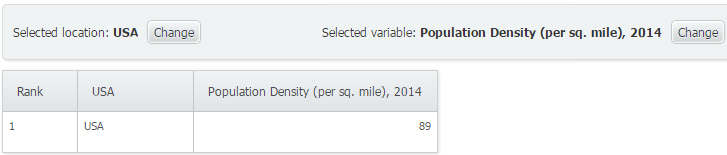
To change how we analyze the variable by, utilize the Analyze Data By feature to analyze USA by States. Doing so yields the following:
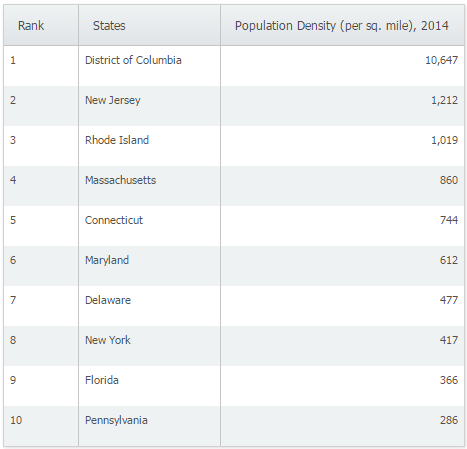
Not surprising, DC comes in first at a density of 10,647 with New Jersey coming in a far off 2nd place at 1,212. Next, we will analyze this variable by city. Unfiltered results yields the following top 10 cities:
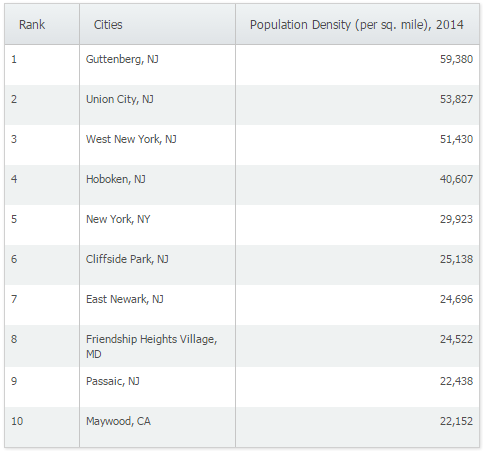
Guttenberg, NJ is the most densely populated incorporated place in the country with a staggering 59,380 people per square mile. A little research into Guttenberg, NJ reveals that the town itself is only 4 blocks wide, with a population of 11,176! It’s easy to see how Guttenberg would be ranked first overall in the United States.
Lastly, apply a population filter to only reveal cities with a population greater than 100,000. The results are shown below:
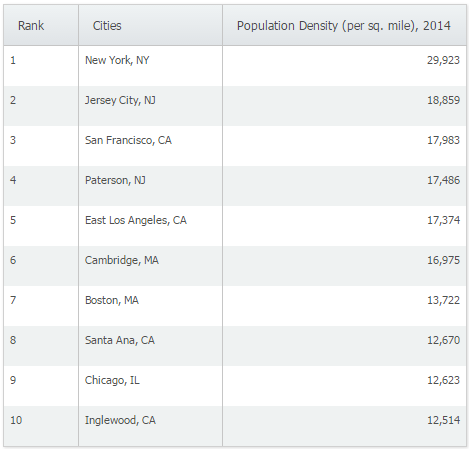
New York, NY and Jersey City, NJ rank first and second respectively as the highest population density per sq. mile for larger cities.
Are there any reports that you would personally like to see? Feel free to let us know in the comments below!
Have you already entered for your chance to win an iPad or Kindle Fire? We will be holding the drawing on April 17, 2015. To enter, simply follow us on Twitter and Like Us on Facebook to get your name in consideration.
More from SimplyAnalytics


Posted on Jan 23, 2015 by Admin
SimplyMap offers a total of 5 unique types of reports: Standard Report, Ranking Report, Business Report, Ring Study, and Location Analysis. This brief write up will define what each repor...
Posted on Aug 22, 2009 by Admin
Lynda Kellam, the Data Services & Government Information Librarian at the University of North Carolina, Greensboro has produced some new tutorial videos to help students learn how to ...
Posted on Mar 04, 2014 by Admin
March 11-15 Indianapolis, Indiana The Public Library Association is prepared for another week of events, workshops and special appearances for librarians and authors. Visit our exh...
Posted on Oct 23, 2009 by Admin
SimplyMap was highlighted in the Wake County, NC Public Library Business Blog today as a valuable tool for business planning. Wake County has access to SimplyMap through NC LIVE, a statew...
Posted on Jul 24, 2013 by Admin
Registration is now open for the North Carolina Library Association Conference! Visit us at the 60th biennial conference (Booth #45) through October 15 - 18, 2013. We have beautiful ca...
Posted on Jan 05, 2018 by Admin
The SimplyAnalytics team is looking forward to exhibiting at the Ontario Library Association Super Conference 2018! Stop by the SimplyAnalytcs booth (115T) and take a look at our newest o...
Posted on Jun 02, 2017 by Admin
We can't wait for ALA Annual this Summer, and the opportunity to share SimplyAnalytics with the ALA community. Stop by the SimplyAnalytics booth (1339) and take a peak at what we've been ...
Posted on May 08, 2018 by Admin
We will be exhibiting at the SLA conference in Baltimore, MD this June. Stop by booth #912 and say hello - we look forward to demonstrating SimplyAnalytics, answering your questions, and ...
Posted on May 08, 2018 by Admin
This summer's ALA conference is in New Orleans and the SimplyAnalytics team will be exhibiting at booth #837. We hope you stop by to learn about new features, check out our new data offer...
Posted on Sep 09, 2015 by Admin
This week’s SimplyMap report will set out to discover what America’s favorite type of music is. We will use data within the premium data package, SimmonsLOCAL to answer the question. The ...