 Go up
Go up


Exploring SimplyMap Data: Internet Search Engines
Posted on May 26, 2016 by Admin
In this week’s report exploring SimplyMap data, we take a look at the variables available relative to internet search engines used. The source of this data will come from the SimmonsLOCAL data set which, as we’ve mentioned before, contains over 60,000 data variables. With that much data available, it’s safe to say that this series will be around for a very long time. Let’s get started!
Our general assumption here is that Google is the most used search engine in the United States. But does the data backup our assumption? Let’s find out.
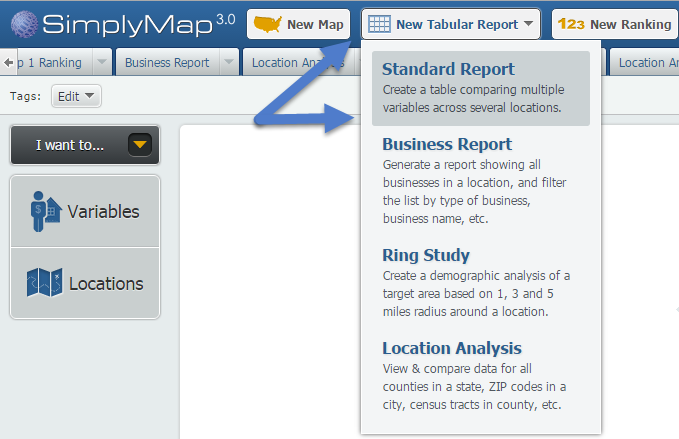
First, create a new Standard Report under the New Tabular Report button:
Next, open the Variables panel and navigate through the following path to find the variables of interest: SimmonsLOCAL » INTERNET » SEARCH ENGINES(COMPUTERS & OTHR DEVICES) » SEARCH ENGINES - HOW USED » SEARCH ENGINE I CURRENTLY USE MOST OFTEN.
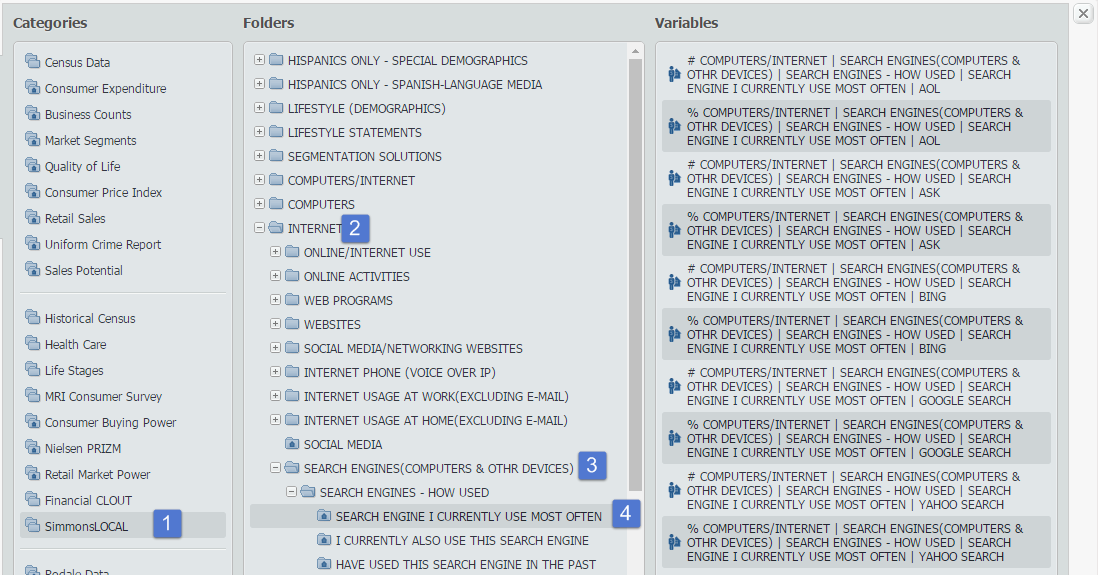
In total, there are four folders that contain search engine data, broken down by:
1. Search Engine I Currently Use Most Often
2. I Currently Also Use This Search Engine
3. Have Used This Search Engine in the Past
4. I Have Never Used this Search Engine
Each folder contains data on five search engines:
1. AOL
2. Ask
3. Bing
4. Google
5. Yahoo
As the path above indicates, we’ll be focusing on the first folder - Search Engine I Currently Use Most Often. Once you have selected the associated percent variables for the 5 search engines, close out your report to compile the data for the United States. Results below!
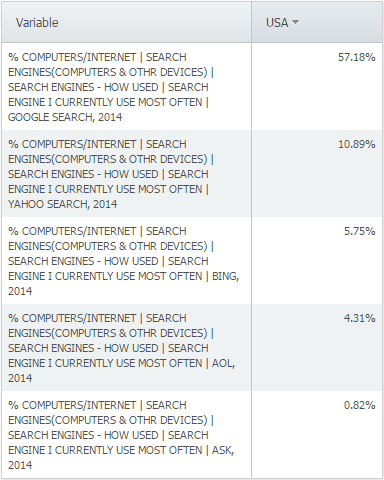
Our assumption was proven correct by the data, although the disparity between the search engines was surprising, with Google being the overwhelming favorite here in the United States.
Last week we posted a map challenging readers to guess what the map was portraying. The correct answer? Average Annual Snowfall (Total Inches)! If you guessed correctly, good job. If not, stay tuned for more!
More from SimplyAnalytics


Posted on Oct 29, 2015 by Admin
Did you know that SimplyMap allows you to search for businesses by NAICS or SIC codes? Searching by these codes is a great alternative to the general keyword search. Using the keyword sea...
Posted on Oct 08, 2019 by Admin
Hello readers! This week’s “From the Help Desk” is short & sweet. Let’s get to it! Question: How do I analyze all of the states at once in a report? Answer: The Ranking Report allows ...
Posted on Nov 24, 2014 by Admin
In this week’s report, we research America’s most educated cities. SimplyMap contains a total of 111 educational attainment variables, including general population and by race. We used th...
Posted on Nov 11, 2014 by Admin
With Veteran’s Day in the US this week, we thought it would be an ideal time to explore some of the variables in SimplyMap that pertain to veterans. Specifically, we wanted to know which ...
Posted on Dec 03, 2012 by Admin
Come visit the Geographic Research booth at the Ontario Library Association Super Conference this season. The conference will take place on January 30 - February 2, 2013 at the Metro Toro...
Posted on Oct 08, 2008 by Admin
Geographic Research, Inc. (GRI) is pleased to sponsor the fourth annual American Collegiate Retailing Association’s Undergraduate Student Retail Analysis Competition. This is the second ...
Posted on Jun 27, 2009 by Admin
The library faculty at Regent University in Virginia recently spotlighted SimplyMap in their Library Faculty Recommendations blog, highlighting its powerful ability to create professional...
Posted on Feb 27, 2015 by Admin
SimplyMap is an excellent tool for market research, and it’s made even more powerful by Nielsen PRIZM data. Nielsen PRIZM is the highest quality market segment data available. Every house...
Posted on Mar 14, 2010 by Admin
The GRI team was honored to learn that SimplyMap was included in this year's Choice Outstanding Academic Title List, published in the January 2010 issue of Choice Magazine. This is a grea...
Posted on Jun 11, 2026 by Admin
SimplyAnalytics is excited to exhibit at ALA Annual 2026 in Chicago! Visit us at Booth #4336 to meet our team, ask questions, and learn more about the latest SimplyAnalytics features and ...